 MOTVIVO


You teach yoga, people follow you from class to class, and a room of your own keeps coming back to mind. The hard part is knowing whether the plan holds up before you sign a lease. This guide on how to open a yoga studio gives you a business plan to fill in: concept, the room (including hot yoga), costs, a break-even sum, teachers, timetable, prices, founding members and your first 90 days.
How to open a yoga studio: start with your concept
Decide what kind of studio you are and who it is for before you look at a property: your style decides the room, the costs and the timetable.
- Your styles. A clear core (say, vinyasa with yin to balance it) is easier to explain and market than ten styles at once.
- Your student. Describe one person: an office worker who wants a 7:00 class, a parent free at 9:30. Trying to appeal to everyone usually reaches no one.
- Heated or not. Hot yoga is a different building project (see below), so decide before you look at spaces.
- What else you’ll offer. Privates, workshops, teacher training or retreats can come later. Plan a studio that works without them.
Weighing reformers too? Our guide on how to open a Pilates studio covers equipment and reformer capacity. A yoga room is limited by floor space, not machines.
How much does it cost to open a yoga studio?
There’s no single figure that fits everyone: it depends on your city, the space and whether the room is heated. List each cost, get local quotes, and keep one-off and monthly costs apart.
| Category | One-off or monthly | How to price it |
|---|---|---|
| Space (rent, deposit, service charges) | Both | Compare units with local agents; ask when the deposit comes back. |
| Fit-out (floor, lighting, sound, air conditioning, changing area, toilet, storage, reception) | One-off | Written quotes from at least two contractors, plus a buffer. |
| Props (mats, blocks, straps, bolsters, blankets) | One-off, then replacements | Enough for a full class, plus replacements. |
| Heating and humidity control (hot yoga only) | One-off, plus higher bills | Quotes from contractors who have built heated studios before. |
| Insurance | Yearly | A local broker, for the business, public liability and teachers. |
| Licences, permits, music | One-off or yearly | Ask your municipality and accountant; ask the music licensing body whether playing music in class needs a licence. |
| Teachers | Monthly | Decide how you pay (see below) and ask local teachers their rates. |
| Software (booking, payments, website) | Monthly | Published price lists plus your card payment provider’s fees. |
| Marketing (photos, sign, launch) | One-off, then monthly | A photographer, a sign, and a launch budget you could afford to lose. |
| Utilities, cleaning, laundry, accountant | Monthly | Ask the landlord for typical bills; get quotes. |
| Opening reserve | One-off | Enough to cover several months of costs while classes fill. |
If you open a hot yoga studio
Heating the room is the easy part; moisture is what catches owners out. A room of people sweating several times a day needs its own heating, ventilation and humidity control, not bigger air conditioning. Without it, condensation and damp can appear within months. Plan for:
- A contractor or engineer who has built heated studios before, and insulation and vapour barriers designed for a humid room.
- A waterproof, slip-resistant floor rated for heat (hardwood warps).
- Showers, time to air the room between classes, and higher electricity bills.
- Health questions before someone’s first heated class, checked by a local lawyer.
Is opening a yoga studio profitable? Do the break-even sum
A yoga studio is profitable once members bring in more each month than the studio costs to run. The number to know is how many paying members cover your monthly costs.
Members needed to break even = monthly fixed costs (including your own pay) ÷ (average monthly income per member − card fees − teacher pay per member)
Classes needed per week = (members × average classes per member per week) ÷ average students per class
Example with made-up numbers (not typical costs, just to show the sum), in euros and before VAT: fixed costs, including your own pay, are €3,500 a month. An average member brings in €80 and costs €4 in card fees. Teachers get €30 a class, so that cost grows with every class you add. Your room fits 20 mats, but plan on 12 per class at first: a member who comes twice a week takes up about a sixth of a class each week, or about €22 a month in teacher pay. So each member leaves about €54: 3,500 ÷ 54 ≈ 65 members. That’s 130 bookings a week, about 11 classes of 12, and teachers cost about €1,430 a month. Every class you teach yourself lowers that cost.
Can your team teach that, at times your students can come? If not, change the plan (a smaller room, lower rent, different prices) before you sign. Count workshops and retreats as a bonus, not as what makes the plan work.
Your budget: a sheet to fill in
Copy this table and fill it in with the quotes you get. The monthly column, with your own pay, gives you the fixed costs for the break-even sum.
| Category | One-off € | Monthly € | Your quotes |
|---|---|---|---|
| Space (rent, deposit, service charges) | |||
| Fit-out | |||
| Props | |||
| Heating and humidity control (hot yoga only) | |||
| Insurance | |||
| Licences, permits, music | |||
| Software | |||
| Marketing | |||
| Utilities, cleaning, laundry, accountant | |||
| Your own pay | |||
| Opening reserve | |||
| Total |
Teacher pay isn’t in this sheet: it grows with every class, so it goes into the sum per member, as in the example above.
Teachers and your first timetable
Teach a good share of classes yourself at first, but budget for teachers from day one. Owners who teach every class have no time to run the business, and in what owners have written about their experience, many say they lost their own practice.
- Agree pay in writing before anyone teaches. A flat rate per class is simple. Pay per student rewards full classes but can leave a teacher with very little in a class with few students, so some studios add a minimum. Changing pay later is where studios and teachers fall out.
- Agree cover: who finds a substitute, how fast, and how they are paid. Ask your accountant whether teachers are employed or freelance.
- Start with fewer classes at the times your student can make, and add one only when others fill.
- Give each new class a fixed trial, say six weeks, then keep, move or drop it. Don’t add a class because one person asks.
How to price yoga classes when you open
Set prices from your break-even sum and keep to a handful of options; too many confuse people just as they want to buy.
- Drop-in: a single class at the highest price per class, for visitors and people trying you out.
- Class pack: say 10 classes with an expiry date, cheaper per class.
- Membership: monthly, unlimited or with a weekly limit. Memberships usually bring steadier income than packs, because they’re paid every month.
- Intro offer: one simple first step that leads into a pack or membership.
Be careful with deep discounts and deal sites. Owners who tried them and wrote about it describe bargain hunters who rarely stayed, and regulars who then expected the low price. See how to price fitness classes for the full method, and class packs vs memberships for which to offer first.
Before you open a yoga studio: test demand and sell founding memberships
Prove people will pay before you sign a lease, then sell memberships before the doors open. Nothing lowers the risk more.
- Test first. Run paid classes in a hired hall or outdoors near your chosen area. Who comes, when, and at what price tells you more than any survey.
- Founding members. Limited places or a deadline, a clear benefit (a founding price kept while they stay), and a message students can forward to a friend.
- Open week: taster classes, booked in advance so you can follow up.
Your first 90 days
Use the first three months to turn first visits into a weekly habit and check your plan against real numbers.
- Month 1: learn every newcomer’s name, ask what brought them, follow up after their first class.
- Month 2: move intro-offer students onto packs or memberships; ask happy students for a Google review and to bring a friend.
- Month 3: review each class against its trial, compare members with your break-even sum, and contact anyone who has stopped coming. See how to keep members coming back.
Hold off on a second room or location until the first is steady; owners who have written about expanding early often say it stretched them too thin.
Yoga studio business plan checklist
Copy this and answer every line in writing. Licences and permits depend on your country and municipality, so check locally which apply.
| Section | Answer these |
|---|---|
| Concept | Which styles? Heated or not? Who is your student, and what times can they come? |
| Demand | How many people already take your classes? Did test classes in the area fill, and at what price? |
| Space | How many mats fit with room between them? Quiet enough, good air, changing area? Lease read by a lawyer, deposit terms clear? |
| Costs | Local quotes for every category in the cost table, one-off and monthly; opening reserve. |
| Break-even | Members needed, classes per week needed, and whether you can teach them. |
| Teachers | Who teaches what; pay and cover agreed in writing; employed or freelance (ask your accountant). |
| Timetable | Opening classes and the trial period for each. |
| Prices | Drop-in, pack, membership, intro offer; cancellation and no-show rules. |
| Legal and insurance | Business registration, local permits, music licence, insurance, waiver and health questions checked by a local lawyer. |
| Launch | Founding offer, Google Business Profile, photos, sign, open week. |
| First 90 days | Who follows up with newcomers; which numbers you check every week. |
How MOTVIVO helps
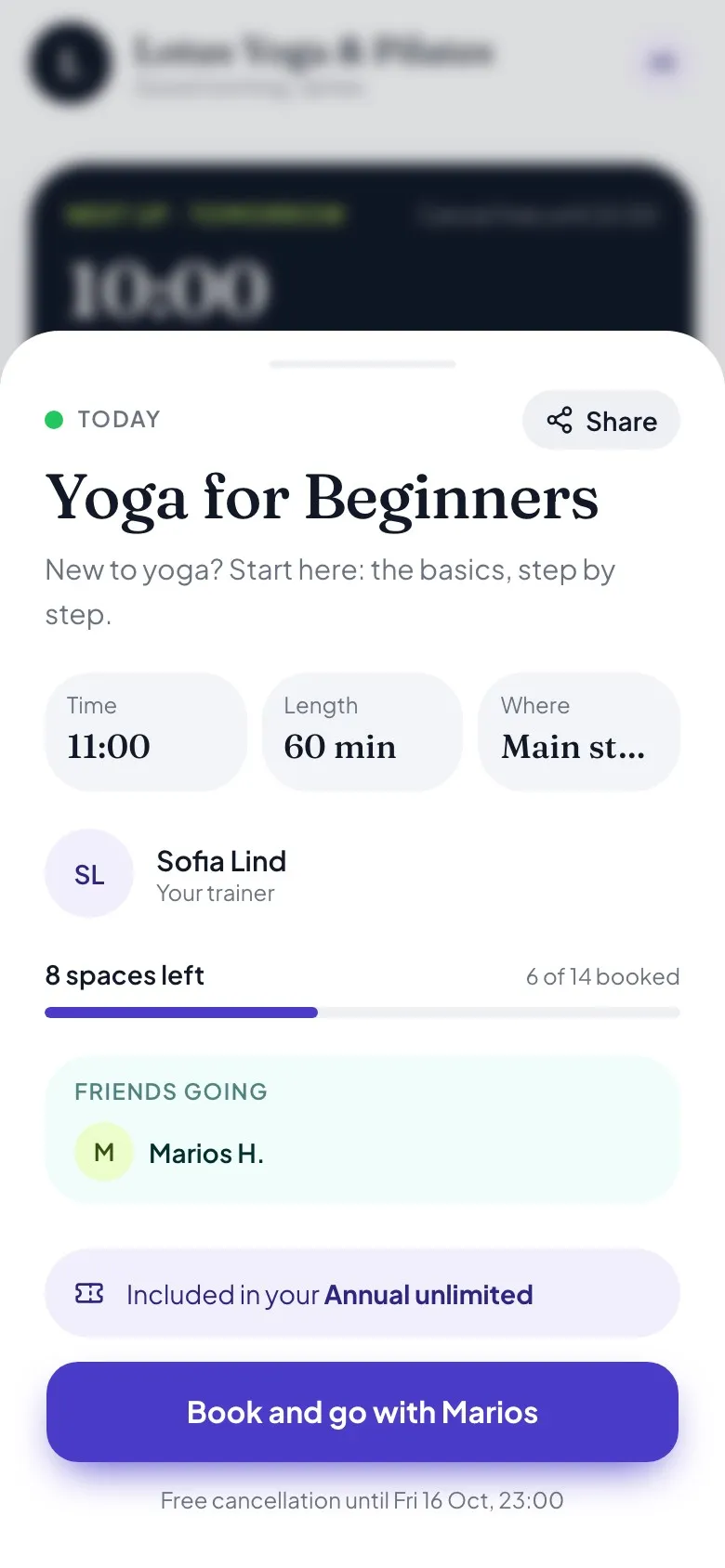
- Students book in your own booking app in two taps, waitlists move people in automatically, and your cancellation rules apply the same for everyone.
- Sell memberships (unlimited or with weekly limits), class packs with expiry dates and drop-ins online through your own Stripe account, or at the desk.
- Waivers and health questions are signed in the booking app before booking, and a club website shows your live timetable.
- Each morning, Today shows what’s worth doing, and Say hello prepares a welcome after someone’s first class for you to send.
See MOTVIVO for yoga studios. The first 14 days are free with no card, then from €19 a month (pricing).
Questions
How much does it cost to open a yoga studio?
There’s no single figure that fits everyone: it depends on your city, the size of the space and whether you heat the room. List the categories (rent and deposit, fit-out, props, insurance, licences, teachers, software, marketing and an opening reserve), get local quotes and add them up. Rent and, for hot yoga, heating and humidity control usually change the total most.
Is opening a yoga studio profitable?
It can be, once enough members pay to cover your monthly costs. Divide your fixed costs by what an average member brings in after fees to find the members you need, then check you can teach enough classes for them. In what owners who struggled have written, the same causes come up: rent too high for the room, deep discounts, and opening a second space too soon.
Can I open a yoga studio with little money?
Yes, if you start smaller than your dream studio. Teach in a hired hall or a shared space first, build a group of regular students, and sell founding memberships before you take on a lease. Choose an unheated room, teach most classes yourself at first, and keep an opening reserve so the first few months, which are usually slow, don’t force rushed decisions.
What licences do I need to open a yoga studio?
It depends on your country and municipality. Ask your municipality and an accountant which registrations and permits apply to your premises and business, ask the local music licensing body whether you need a licence to play music in class, and have a local lawyer check your lease and your waiver before you open.
What do I need to open a hot yoga studio?
Everything a normal studio needs, plus a room built for heat and moisture: dedicated heating, ventilation and humidity control designed by someone who has built heated studios, insulation suited to a humid room, a waterproof non-slip floor, showers and changing space, and health questions before a first class. Expect higher energy bills and time to air the room between classes.