 MOTVIVO


How much to charge for a fitness class is one of the hardest decisions for a studio owner. Copy the studio down the road and you may lose money on every class; guess high and you worry nobody will book. This guide gives you a method instead of a number: your real cost per class, how class size changes it, a local market check, drop-in, pack and membership prices that add up, and how to raise prices fairly. It works for yoga, Pilates, martial arts, dance and gym classes.
How much to charge for a fitness class: start with your cost per class
Start with what one class costs you to run, not with what other studios charge. That is your floor: below it, every class loses money.
Work it out from your own figures for one typical month:
- Fixed costs per month: rent, utilities, insurance, software, cleaning, marketing, accountant, and a reserve for replacing equipment.
- Divide by the classes you actually run in that month to get each class’s share.
- Add the teacher’s pay for that class, including any prep time and employer costs. If you teach it yourself, still put in a teacher’s rate, or the sum only works until you need a cover teacher.
- Add the costs that grow with each sale, such as card and online payment fees.
The result is your cost per class. Still planning? Use estimates and revisit them after three months of trading; our guide to opening a Pilates studio and working out your break-even walks through the start-up side.
Capacity and fill: how to price fitness classes by real class size
Divide your cost per class by the people who usually attend, not the spots in the room. Twelve mats with six people costs you twice as much per person as a full class.
Here is a hypothetical example. Say one class costs you €80 to run once fixed costs, teacher pay and fees are counted:
| People in class (example) | Cost per person (example) |
|---|---|
| 4 | €20.00 |
| 6 | €13.33 |
| 8 | €10.00 |
| 10 | €8.00 |
Same room, same teacher, very different numbers. Use the attendance you actually get in an average week, not the attendance you hope for. Then add the margin you need: your own pay as the owner, growth, and a cushion for quieter months. That gives you your minimum price per class.
No-shows count too: a booked but empty spot can keep someone on the waitlist out. A clear late-cancellation and no-show policy protects the attendance your prices depend on.
How to price Pilates classes: reformer vs mat
Reformer classes cost more per person: fewer people fit and the equipment is expensive. Run the sum for each class type separately:
- Reformer: fewer spots, the machines’ cost and upkeep, often a more specialised teacher. Higher cost per person, so a higher price.
- Mat: more people fit in the same room and the kit is cheap, so the cost per person falls as the class fills.
The same goes for heated yoga, small-group strength or visiting teachers: if a class type costs more to run, price it separately rather than letting your other classes quietly pay for it.
Check your local market, without copying it
Your costs set the floor; your local market shows how far above it you can go. Look at five or six studios your members would realistically choose between.
- Note their drop-in, main pack and main membership, and the price per class of each.
- Compare like with like: class size, length, equipment, teacher experience, facilities.
- Ignore price lists from other countries or big cities; only studios your members could actually walk into matter.
If your minimum comes out above what everyone nearby charges, don’t just cut it. Look at costs first (fewer, fuller classes) or offer something clearly different, such as smaller classes. Pricing far below comparable studios is hard to climb back from.
Yoga class pricing: drop-in, pack and membership price per class
Every option you sell should come out at or above your minimum price per class, counted the way members really use it.
- Drop-in: the price is the price per class, usually your highest.
- Class pack: pack price ÷ number of classes.
- Membership: monthly price ÷ the classes a typical member actually takes in a month. For unlimited, use your most frequent members: they set the real price per class.
If your busiest unlimited members end up below your minimum, the fix is usually a weekly or monthly class limit, a higher unlimited price, or keeping costlier classes such as reformer outside it. Choosing which formats to offer and how to arrange them as a price ladder is a separate decision, covered in class packs vs memberships.
Worksheet: work out your own class price
Fill this in for each class type (mat, reformer, kids, private) with one real month of figures.
A. Fixed costs this month (rent, utilities, insurance, software, cleaning, marketing, equipment reserve): €____
B. Classes run this month: ____ → fixed cost per class = A ÷ B = €____
C. Teacher pay for one class (a teacher’s rate even if you teach it): €____
D. Payment fees per class, roughly: €____ → cost per class = (A ÷ B) + C + D = €____
E. Average people per class: ____ → cost per person = cost per class ÷ E = €____
F. Margin you need per person: €____ → minimum price per class = cost per person + F = €____
G. Check: drop-in, pack and membership price per class (as members really use them) all at or above the minimum? Yes / No
Raising class prices fairly
Raise prices when costs have gone up, classes are regularly full, or the worksheet shows you below your minimum. Small yearly rises are easier to accept than a big jump after years of nothing.
- Decide who it applies to and when. A common approach: new prices for new members straight away, and existing members keep their current price until a clear date a few weeks or months later.
- Honour what people have paid for. Packs and memberships already bought keep their terms until they run out or renew.
- Tell regulars early and in person. The people who get upset are usually the ones who found out at the desk.
- Explain briefly, don’t apologise, and change prices everywhere (website, booking app, desk, social media) on the same day.
For contract and renewal terms on existing memberships, check with a local lawyer or accountant before you change them.
A price increase message you can adapt
Hi [first name], a quick note before you hear it anywhere else. From [date], our prices change: the drop-in becomes [price], the 10-class pack [price] and the monthly membership [price].
It’s the first change since [year]. Our [rent / teachers’ pay / equipment] costs have gone up, and we want to keep classes small and our teachers with us.
Anything you have already bought keeps its price, and as a current member your membership stays at [current price] until [date]. If you have questions, ask me after class. Thank you for being part of the studio.
Discounts to avoid (and the ones worth keeping)
Avoid discounts that lower what your regulars pay; keep the ones that lead new people to your normal prices.
- Avoid open-ended sales. They teach regulars to wait for the next one.
- Avoid deep discounts through deal sites. Owners who tried them describe buyers who left when the deal ended, a big share kept by the platform, and less per head for the teacher.
- Keep a time-limited intro offer for first-timers only. See our guide to intro offers that turn into regulars.
- Keep rewards for loyalty and referrals, such as a free class for bringing a friend. They thank people rather than cut your price.
What owners run into when pricing classes
- Guilt about charging more. Many owners feel uneasy charging more to a community they care about. The worksheet turns the price into what it costs to keep the studio open.
- Smaller classes, same price. Capping classes smaller means each person has to pay more. Re-run the numbers whenever capacity changes.
- Members think per month, not per class. A small rise per class feels bigger to someone who comes three times a week. Show what their usual month will cost, and point them to the option that suits them.
- Rent goes up, prices don’t. Prices set at opening and never reviewed slowly squeeze the owner’s pay. Put a yearly review in your calendar.
How MOTVIVO helps
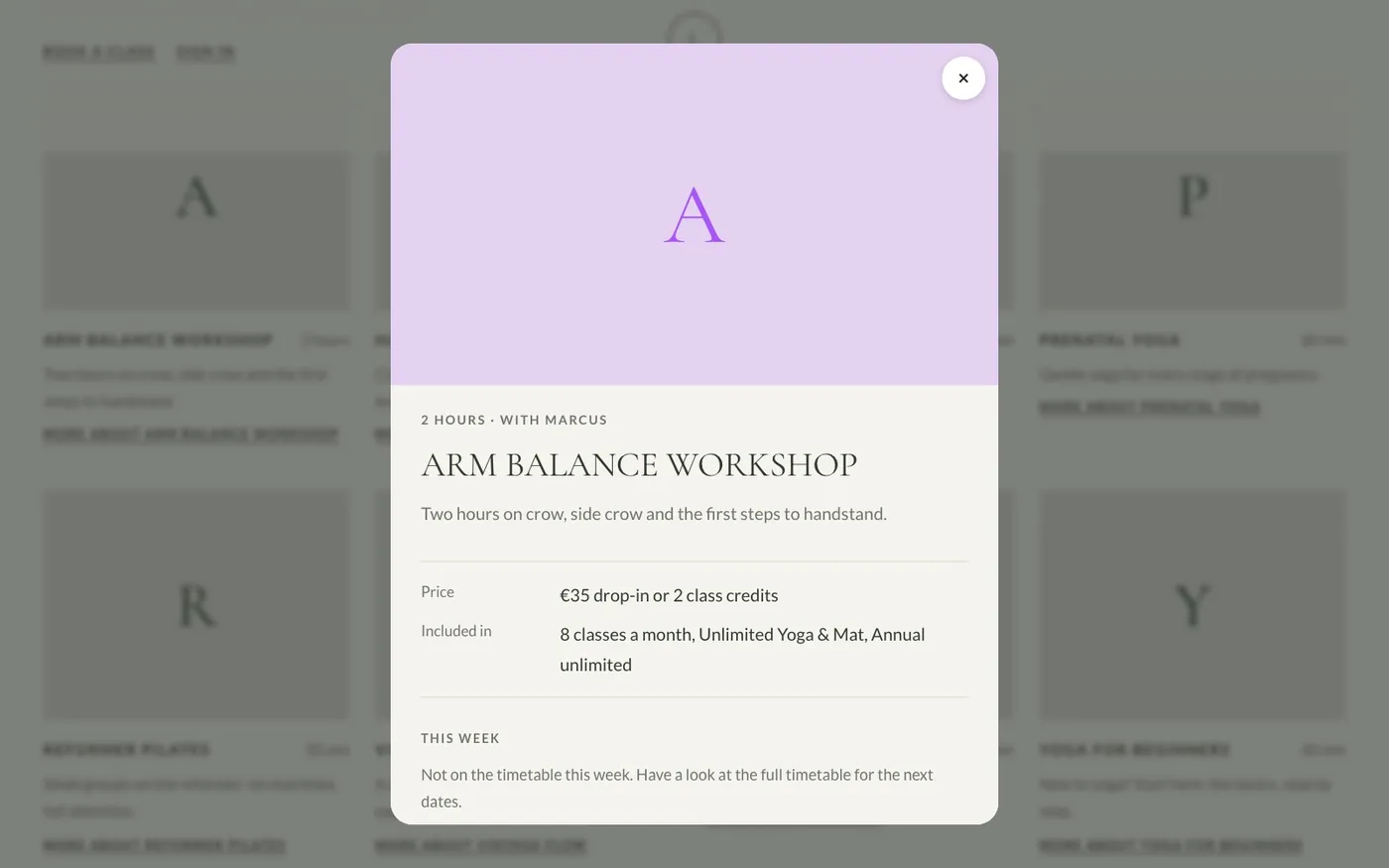
- Set drop-in prices, class packs with credits and expiry dates, and memberships (unlimited or with weekly or monthly limits, for a month, a term or a year), and sell them online through your own Stripe account or at the desk.
- Members see whether a class uses their membership or their credits before they book, in your club’s own booking app.
- Reports show class fill and your busiest and quietest times, and each morning Today points out the emptiest class still to come and memberships ending soon, so you can talk to members at the right moment.
See how it works on the memberships and class packs page. The first 14 days are free, no card needed.
Questions
How much should I charge for a fitness class?
Charge at least your cost per person plus the margin you need. Add up a month’s fixed costs, divide by the classes you run, add the teacher’s pay and payment fees, then divide by the number of people who usually attend. Add your margin, then compare the result with studios nearby that offer something similar. There is no single right price; there is a minimum that works for your studio.
Should reformer Pilates cost more than mat Pilates?
Usually, yes. Reformer classes hold fewer people, the machines are expensive to buy and maintain, and teachers are often more specialised, so each spot costs you more. Work out the cost per person separately for reformer and mat classes. If you include reformer in a general membership, check that your most frequent members still pay at least your minimum per class.
How often should I raise class prices?
Review your prices once a year and raise them when your costs have gone up or your classes are regularly full. Small, regular changes are easier for members to accept than a large jump after several years. Give existing members clear notice and a date, honour packs and memberships already bought, and tell your regulars in person before the new prices go online.
Should existing members keep their old price?
Many studios let existing members keep their price for a set period, then move everyone to the new prices on a clear date. Keeping old prices forever sounds kind, but over time you end up with members paying very different amounts for the same class, which is hard to manage and can feel unfair. Whatever you choose, say it plainly in your announcement.
How do I price a private yoga or Pilates session?
Use the same method with one person in the room. Take the cost of the hour (a share of fixed costs, the teacher’s pay including preparation, and payment fees) and add your margin. Because a single client carries the whole cost, a private session costs far more per person than a group class. Check what comparable teachers nearby charge before you settle on a price.