 MOTVIVO


When someone in Limassol wants to try reformer Pilates, they don’t search for your studio’s name. They type “reformer pilates limassol” or «πιλάτες λεμεσός», look at the map, read a few reviews and tap whoever looks right. To get found on Google in Cyprus, your studio or gym has to show up for those town searches and look like the obvious choice when it does. This guide covers what you can do yourself, from your Google Business Profile to your website and local links, plus a checklist to copy.
How people in Cyprus search for a studio or gym
People search by class type plus town, often with one extra word. Google’s own search suggestions for Cyprus show what they add:
- Town and neighbourhood: pilates paphos, yoga nicosia, pilates nicosia strovolos, yoga nicosia engomi, gym limassol germasogeia, pilates kiti larnaca.
- Price: gym paphos prices, reformer pilates limassol price, pilates larnaca prices.
- Right now: gym limassol open now, gym paphos open sunday, gym limassol day pass, pilates near me.
- The kind of class: clinical pilates paphos, prenatal yoga larnaca, aerial yoga nicosia, pilates near me for beginners, martial arts for kids limassol.
- Greek, often mixed with English: «πιλάτες λεμεσός», «reformer pilates λευκωσία», «yoga λεμεσός», «gym λευκωσία».
Most of these searches show a map first, so your Google Business Profile does most of the work. The extra words (area, prices, hours, class types) should be easy to find on your profile and your website.
Google says local results depend mainly on relevance (how well you match the search), distance and prominence (how well known you are, including links and reviews). You can’t change distance, and Google states there is no way to pay for a better local ranking. Relevance and prominence are where your work counts.
Set up your Google Business Profile to get found on Google
Claim and verify your free Google Business Profile, then fill in every field that applies. A complete, accurate profile is the first thing Google itself recommends.
Name: your real name, nothing added
Use the name on your sign and your invoices. Google’s guidelines don’t allow extra words such as “Best Pilates Limassol” or a tagline in the name. Profiles get edited or suspended for it. Your town belongs in the address, the description and your website.
Category: the most specific one
Search the category list for what you are (Pilates, yoga, gym, dance, martial arts) and pick the most specific match as your main category. Google asks for the fewest categories that describe your core business. Think “this business is a Pilates studio”, not “this business has a sauna”.
Address, hours and holidays
- Use your real street address with the right pin on the map. A PO box or virtual office isn’t allowed.
- Enter your regular opening hours, the ones that match your front door and your website.
- Add special hours before holidays: Christmas, Easter, Kataklysmos. Otherwise people turn up to a locked door.
Description, phone, website and booking link
Write the description the way you’d explain your studio to a new neighbour: what you teach, who it’s for, where you are. For example: “Small reformer and mat Pilates studio in Germasogeia, Limassol. Classes in English and Greek, beginners welcome, clinical Pilates on Tuesdays.” Add a phone number people actually answer, your website, and a direct booking link if your profile offers one, so people land on the timetable, not your home page.
Photos, posts and reviews
Once you’re in the results, photos and reviews decide whether people tap. Someone comparing three studios on the map looks at faces and stars first.
- Photos: your logo, a cover photo, the entrance from the street (so first-timers find you), the room, a real class in progress (with permission), your teachers. Google asks for real, well-lit photos without heavy filters, and may show a customer’s photo instead of a poor cover.
- Posts: a short update with a photo when something changes: a new beginners class, a workshop, holiday hours, an intro offer. Posts show on Search and Maps.
- Reviews: Google says more reviews and positive ratings can help. Ask members at good moments, such as a milestone class or a return after a break (the same moments that help keep members coming back), reply to every review, and never offer a reward for a review: Google’s policy doesn’t allow it. Our guide on how to get more Google reviews has the timing and the messages.
A website that helps you get found on Google
Your website should answer the searches above in plain words: your town and area, your class types, your prices, your timetable, and a way to book. A site with only a logo and a phone number gives Google nothing to match.
- Your town and neighbourhood in the text: “reformer Pilates in Strovolos, Nicosia” in the page title, the first paragraph and the contact section. Naturally, not stuffed.
- Each class type by its real name: reformer, mat, clinical, prenatal, aerial, kids’ kickboxing, with two lines about who it suits.
- Prices on the page: a drop-in price, a class pack and a membership are enough. Still working them out? See how to price fitness classes.
- A live timetable and booking: someone searching “pilates near me now” wants tonight’s classes and a Book button, not a message and a wait. For the schedule itself, see how to plan a class timetable.
- Contact and directions: phone, WhatsApp, email and a map link, plus a note on parking if it’s tricky.
The same name, address and phone, in English and Greek
Use exactly the same name, address and phone number everywhere: Google, your website, Facebook, Instagram, Apple Maps and directories. When details disagree, people call an old number and Google has to guess.
Cyprus adds a twist: two languages, two spellings of some towns (Limassol and Lemesos, Nicosia and Lefkosia) and street names in Greek or Latin letters. People search the English town names, or the Greek ones in Greek letters. So:
- Pick one way to write your name and address in Latin letters and use it everywhere.
- Have a Greek version of your website, or at least a Greek paragraph that names your town and classes in Greek (Λεμεσός, πιλάτες, γιόγκα).
- Keep your hours identical on the website and the profile. Google can accept changes other people suggest to your profile if you don’t respond, and it checks them against public information such as your own website.
Local links and mentions in your town
Links from other local websites tell Google that real people know you. In Cyprus the best ones usually come from things you already do:
- Your municipality or community: a free class at a municipal event, a stand at a town festival, a session in a local park. Ask for a link on the event page.
- Partners: physiotherapists who refer clients to clinical Pilates, a running club, a nearby café, a hotel whose guests need a yoga class. Swap a mention on each other’s websites.
- Local news and guides: local news sites and English-language community pages often cover a charity class, a kids’ tournament or a new studio opening.
What owners run into
- Moving or renaming triggers re-verification. Owners report suspensions after changing the name or address, and slow appeals. Plan the change, keep proof ready (sign at the entrance, lease, registration documents) and change one thing at a time.
- Video verification needs a visible sign. Google may ask for a short video showing your premises. A studio upstairs behind a shared, unsigned entrance is harder to verify.
- Old hours keep coming back. Last year’s holiday hours, or edits suggested by strangers, end up on the profile. A monthly check catches them.
- Duplicates. An old profile from a previous owner or an earlier address competes with yours and splits your reviews. Claim it, or report it to Google as a duplicate.
Checklist: get found on Google in your town
Do the first part in one afternoon; keep the rest as a habit.
| When | Task | Done |
|---|---|---|
| Once | Claim and verify your Google Business Profile; remove or merge duplicates | |
| Once | Real name only; most specific main category; correct pin and address | |
| Once | Opening hours, phone/WhatsApp, website and booking link | |
| Once | Description with your town, area, class types and languages | |
| Once | Logo, cover, entrance, room, a real class, teachers | |
| Once | Website: town and area, class types, prices, live timetable, booking, contact and map | |
| Once | Greek version or Greek paragraph naming your town and classes | |
| Once | Same name, address and phone on Facebook, Instagram, Apple Maps and directories | |
| Every week | Ask happy members for a review; reply to new reviews | |
| Every month | One post with a photo; check hours and suggested edits; add new photos | |
| Before holidays | Special hours on the profile and the website | |
| Every season | One local event, partner or press mention with a link |
How MOTVIVO helps
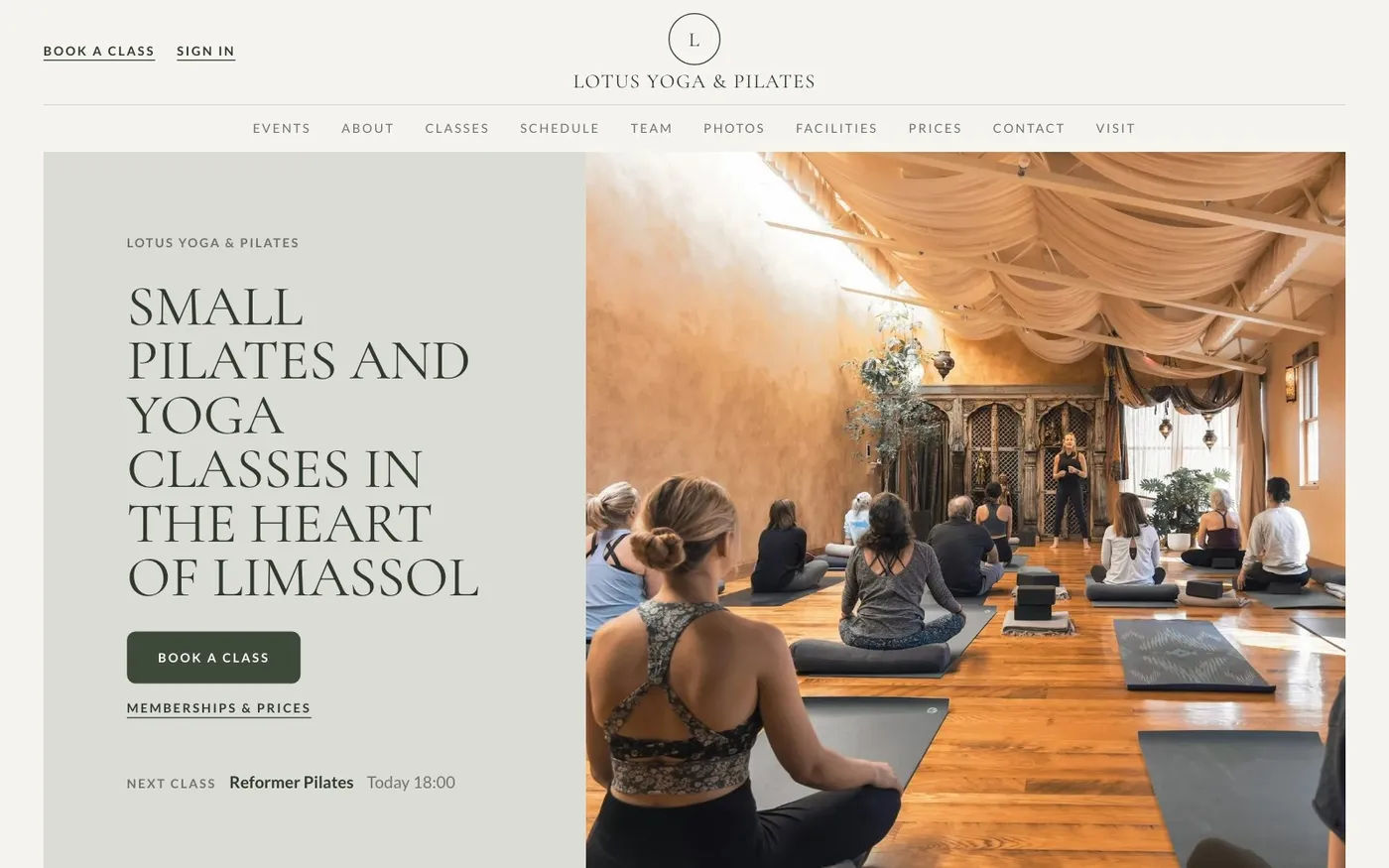
- Your club website shows your live timetable and prices with booking. Visitors tap a class to see its teacher, price, the memberships that include it and this week’s times, and contact buttons cover call, WhatsApp, email, Instagram, Facebook and directions.
- You see visitors, Book taps, bookings and new members from the site, so you know whether people who find you actually book.
- Review invitations go to members at the moments you choose, on Google or Trustpilot, with no rewards attached. Members can also tell you something privately instead.
Questions
How long does it take to show up on Google Maps?
Your profile can appear on Maps once it’s verified. Appearing for searches like “pilates paphos” is different: it depends on relevance, distance and prominence, and nobody can promise a position or a date. A complete profile, steady reviews and a website that names your town and classes give Google the most to work with.
Should I put “Pilates Limassol” in my business name on Google?
No, unless it’s genuinely part of your real name, on your sign and invoices. Google’s guidelines don’t allow extra keywords, locations or taglines in the business name, and profiles get edited or suspended for it. Put your town and class types in the description, your website’s page titles and your posts instead, where they help without putting the profile at risk.
Should my website and Google profile be in English or Greek?
Both, if you can. People in Cyprus search in English (“yoga nicosia”) and in Greek, often mixed («pilates λεμεσός»). Keep one fixed spelling of your name and address on the profile, and offer your website in English and Greek, or at least a Greek paragraph naming your town and classes. Write the Greek naturally rather than translating word for word.
I teach in a rented hall without a sign. Can I still have a profile?
It depends on how you work. Google’s guidelines require a real location where you serve customers, and verification may ask you to show it, which is harder in a shared building without your name outside. Read Google’s current guidelines for your situation before creating the profile, and ask the venue whether you can put up a small sign with your name.
Do I need to pay for ads or an agency to be found on Google?
No. A Google Business Profile is free, and Google states there is no way to pay for a better position in local results. Ads appear in a separate, labelled place. Most of what helps a small studio get found is in this guide and can be done by the owner: a complete profile, good photos, regular reviews, a clear website and a few local links.