 MOTVIVO


Your 7pm reformer class has a waitlist every week, while the 10am flow on Wednesday rarely gets past three people. You know the timetable could work harder, but every change feels risky, because regulars plan their week around it. This guide shows you how to build a class timetable that fills: when to put classes, how to arrange levels so beginners have somewhere to grow, how to plan around instructors and the room, and how to test, change and cancel classes fairly. There’s a weekly template to copy at the end.
Start your class timetable with when people are free
Build the timetable around the hours your members can actually come, not the hours that suit you. For most studios that means two busy windows on weekdays and one at the weekend, with quieter time in between.
- Before work. Early classes suit people with office hours. They come for the same slot on the same days, so keep these times steady.
- After work. The early evening is usually the busiest stretch of the week. Your strongest classes and teachers belong here.
- Mid-morning. Quieter, but it suits parents after the school run, shift workers and retired members. Gentle, beginner and specialist classes often do well here.
- Lunchtime. Works near offices, if the class fits a lunch break.
- Weekends. Saturday morning is often strong. Sunday depends on your area: try one class before committing to more.
The best times for fitness classes are the ones your own members book, so look at your bookings and ask people. A two-question message works: “Which days can you come?” and “Morning, lunchtime or evening?” New studio with no data yet? Ask on your waiting list or Instagram before you publish the first timetable.
Plan class levels and progressions
Give every level a clear place in the week, so a beginner can see the path from their first class to the classes your regulars love. A timetable full of “all levels” classes looks open to everyone but often suits nobody: beginners feel lost and experienced members feel held back.
- Name levels plainly. “Beginners”, “Open” and “Strong” (or Level 1, 2, 3) say more than clever class names. Add one line about who each class is for.
- Put beginner classes at popular times. New people have the same jobs as everyone else. A beginners’ class only at 11am on a Tuesday quietly tells them “not for you”.
- Offer a next step. If someone does Beginners Reformer on Monday, there should be an Open class later in the week they can move up to when they’re ready.
- Consider a short beginners’ course. A fixed course (say, four weeks on the same evening) gives newcomers a group to start with and a natural moment to join. It pairs well with an intro offer for new members.
Spacing, instructors and room turnover
Space your classes so each one has room to breathe: time for the room to reset, for teachers to rest, and for members to find a class on the days they’re free.
Room turnover
With no gap, the next group waits in the doorway while the last one rolls up mats. Reformer studios need extra time to wipe down machines and reset springs and straps. Hot yoga needs time to air the room. Plan the slot, not just the class: a 50-minute class in a 60-minute slot leaves 10 minutes to turn the room around. Time it on a real changeover and adjust.
Instructor availability
Collect each teacher’s availability before you draw the grid, and fill the busiest slots first. Keep the same teacher on the same class where you can: members often follow a person as much as a time. Avoid giving one teacher four classes in a row, including you. If you teach most of the week yourself, write down which classes you’d hand over first, so the timetable can grow without depending on you.
Spread across the week
Two similar classes on Monday and none until Thursday make it hard to come twice a week. Mirror days where it helps (Monday and Wednesday the same, Tuesday and Thursday the same), so the timetable is easy to remember.
A weekly class timetable template
Here’s an example for a small yoga and Pilates studio with one room and three or four teachers. Copy the shape, then change the times, classes and levels to fit your members.
| Time (example) | Mon / Wed | Tue / Thu | Fri | Sat | Sun |
|---|---|---|---|---|---|
| 07:00 | Reformer Open | Yoga Flow | Reformer Open | ||
| 09:30 | Gentle Yoga | Mat Pilates Beginners | Yoga Flow | Reformer Beginners | Yoga Flow |
| 11:00 | Pre/postnatal or mobility | Reformer Open | |||
| 18:00 | Reformer Beginners | Reformer Open | Yoga Flow | ||
| 19:00 | Reformer Strong | Yoga Strong | |||
| 20:00 | Yin or Restorative | Reformer Open |
What makes this work:
- The busiest hours carry the most classes, and the quiet hours carry fewer, more specialised ones.
- Beginners have an evening and a weekend option, and an Open class to move up to.
- Mirrored days make it easy to remember: “I do Reformer on Mondays and Wednesdays at 7.”
A gym or martial-arts school can use the same grid: swap in your formats, and keep kids’ classes in the late afternoon, after school. Before you add a class, check it covers its costs; the guide on how to price fitness classes shows how to work out what each class needs to earn.
Seasonal changes to your timetable
Plan a summer timetable and a school-term timetable rather than letting classes empty out unexpectedly. Routines change when schools close, when it gets hot and when people travel.
- Summer. In hot months, early mornings and later evenings can hold up better than the middle of the day. Merge quiet classes instead of running several half-empty ones.
- School holidays. Parents’ free time moves. Kids’ classes may pause or move to mornings.
- New year and September. More people start something new. Have beginner classes and a course ready before these months begin.
- Announce it early. Publish the seasonal timetable a few weeks ahead with the date it starts and the date the usual timetable returns.
How to test and change your class timetable
Change one thing at a time, give it long enough to show a pattern, and decide with your bookings rather than a hunch. Constant tinkering loses regulars.
- Give a new class time. Run it for several weeks, and decide in advance when you’ll review it. A new class rarely fills in its first week.
- Read the waitlist. A class with a waitlist every week isn’t only a success: it’s members who wanted to come and couldn’t. Add a second session next to it, at the same level.
- Before cutting a quiet class, try one fix. Change the time, the level or the teacher, or tell your members about it directly. Then review again.
- Review on a schedule. Look at every class once a term, not every week. Make changes in one batch, so members get one announcement instead of many.
Cancelling low-attended classes fairly
Two different things get called “cancelling a class”, and each needs its own rule.
- One session with too few bookings. Decide a minimum number in advance, based on what the class costs to run, and write it in your studio rules. Check at a fixed time (for example, the evening before), not five minutes before class. Tell everyone booked personally, give the credit back or offer another class, and keep it consistent. Your members’ terms should say what they get; check the wording with a local lawyer.
- A class leaving the timetable. Give regulars notice (a couple of weeks, say), explain why, and point each of them to a similar class. If you can, tell the regulars yourself before the general announcement.
The same fairness applies the other way: members cancelling late empties classes too. A clear late cancellation policy means spots go to the waitlist in time.
What owners run into
- A teacher leaves and the class goes with them. Members bond with a person. When a class changes hands, let the new teacher co-teach or alternate for a few weeks first.
- The owner teaches everything. The timetable ends up shaped around one person’s energy. Hand over one regular class first, and grow from there.
- Too many classes too soon. Half-empty classes feel worse to members than fewer full ones. Start lean.
- The favourite class moves without warning. Regulars plan their week around it. Moving it suddenly can cost more than a quiet slot ever did. Members who feel part of a regular class are the ones who stay; more in how to keep members coming back.
How MOTVIVO helps
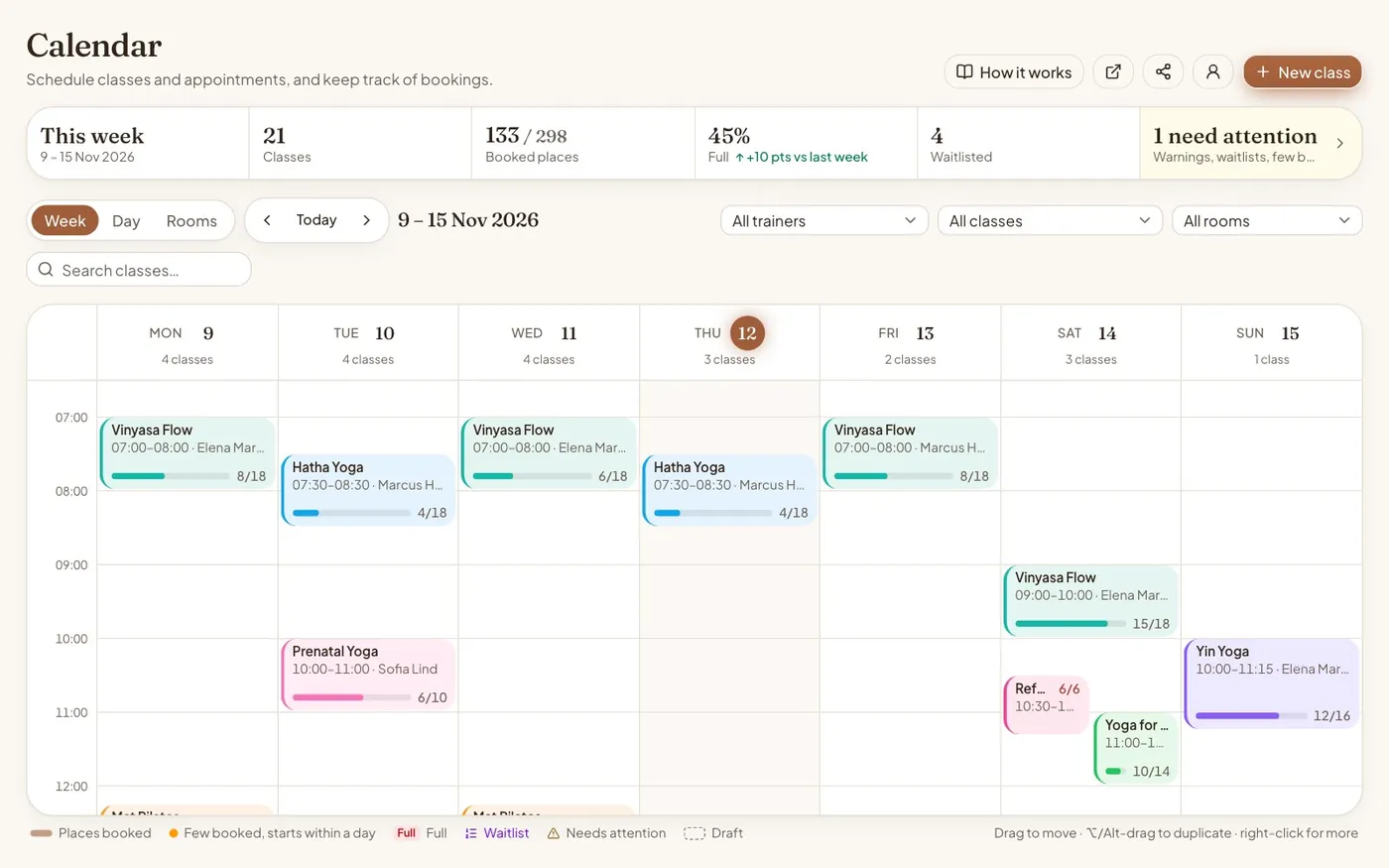
- Build your week once and it repeats. Move a class by dragging it, and you’re warned before a trainer or room clash. Trainers’ availability and time off are in staff management, so you plan around them.
- Your live timetable shows on your club website and in your own booking app, where members book in two taps. Waitlists move people in automatically when someone cancels.
- If you cancel a class, everyone booked is told. Each morning, Today shows your classes and points out the emptiest class still to come, while there’s time to fill it.
- Reports show class fill and your busiest and quietest times, which is what you need for a timetable review. See timetable and scheduling.
Questions
What are the best times for fitness classes?
For most studios, the best times for fitness classes are before work, in the early evening and on Saturday morning, because that’s when people with jobs are free. Mid-morning suits parents, shift workers and retired members. These are starting points: your own bookings and a quick question to members tell you more than any general rule.
How many classes should a new studio start with?
Start with fewer classes than you think, placed at the busiest times, and add more when they fill. A small timetable of well-attended classes feels lively and is easier to staff. A long timetable of half-empty classes costs teacher time and makes the studio feel quiet. Let waitlists tell you where to add the next class.
How much time should I leave between reformer classes?
Leave enough time to wipe down every machine, reset springs and let one group leave before the next arrives. Many studios run a shorter class inside an hour-long slot to make room for this. Time a real changeover in your own room, with your own number of reformers, and build that gap into every slot on the timetable.
When should I cancel a class for low attendance?
Cancel a single session only by a rule you set in advance: a minimum number of bookings, checked at a fixed time well before class. Base the minimum on what the class costs to run. Tell booked members personally and give them their credit back or another class. For a class that’s quiet week after week, try changing its time, level or teacher before removing it.
How often should I change my class timetable?
Review your class timetable once a term and make changes together, with a few weeks’ notice. Regulars build their week around your classes, so frequent changes cost trust. The exceptions are a class with a waitlist every week, which deserves a second session soon, and seasonal timetables for summer or school holidays, planned and announced in advance.