 MOTVIVO


A good challenge gives members a reason to come this week, not “some time”. A bad one ends with three keen regulars racing each other while everyone else quietly gives up. This guide collects fitness challenge ideas for gyms, yoga and Pilates studios that work for real groups of members: class-count, variety, bring-a-friend and beginner challenges, plus how to set the goal, choose rewards, keep it fair, announce it and see whether it worked.
What makes a good fitness challenge for a gym or studio
The best fitness challenges are simple enough to explain in one sentence, reachable for an ordinary member, and end with a reward everyone who finishes receives. Owners who have run many challenges tend to land on the same few rules:
- One clear goal. “10 classes in November” beats a points system with eight ways to score.
- Everyone who finishes wins. A prize for the top three only motivates the top five. One owner who switched from “top three” to “everyone who reaches the goal” found the whole room kept trying.
- Short and dated. A month is long enough to build a habit and short enough to stay exciting. Start and end on dates that suit you, not in the middle of a holiday week.
- Visible progress. People keep going when they can see “7 of 10”. Paper cards get lost in gym bags, so keep the board at the studio or track it in your booking app.
- About showing up, not about bodies. Count classes, not kilos. Weight-loss challenges push some members towards crash diets and make others feel they don’t belong.
10 fitness challenge ideas for gyms and studios
Pick one idea per month and rotate them over the year. Each works for a gym, studio, martial-arts or dance school.
Class-count challenges
- The monthly class challenge. A set number of classes in a calendar month, for example “12 in October”. The simplest one to repeat.
- Twice a week, every week. At least two classes in each week of the month. It rewards a steady rhythm instead of a burst in the last few days.
- Early bird or lunch club. A number of classes at a quieter time, such as before 8:00 or at 13:00. Good for filling times that need it.
Variety challenges
- Studio bingo. A card of squares: a new class type, a new instructor, an early class, a class with a friend, a weekend class. A line earns a small reward, a full card a bigger one. Studios that run bingo often add simple rules: one square per class, and no more than two squares a day.
- Try every class. Each class on your timetable once in a month. It suits studios where members stick to one class and never discover the rest.
- Every instructor. One class with each teacher. It makes cover classes less of a shock.
Bring-a-friend challenges
- Train together. A number of classes taken with a friend who is also a member. People rarely skip a class when someone is waiting for them.
- Bring a guest. Each member brings one guest during the month; the guest gets a welcome and the member a reward. Follow up with every guest, or the effort is lost. More ideas in referral and bring-a-friend ideas.
Beginner and returner challenges
- First month, eight classes. For new members only: a gentle goal that turns a first visit into a habit. Pair it with your intro offer.
- Welcome back. For members who haven’t come for a while: four classes in four weeks. Invite them personally rather than announcing it to everyone.
Yoga and Pilates studio challenge ideas
For experienced yoga students, a challenge works better when it offers something different rather than something harder: a different style each week (yin, flow, restorative), or a few minutes of breathing at home on the days in between. In a Pilates studio, a “mat and reformer” bingo or a month of one class on each piece of equipment you have works well. Leave out daily-streak challenges in the studio: members need rest days, and a 30-day streak rewards the ones who skip them.
Fitness challenge ideas for groups: setting the goal
Set the goal from how your members train now: a little more than a typical regular already does. Look at last month’s attendance and find what a steady regular managed. Say a regular came about twice a week, roughly eight classes: a goal of 10 is a stretch they can reach, and 20 is a goal only a handful will try.
Then check three things owners often miss:
- Membership limits. A member on “8 classes a month” can’t reach 12 without paying more. Either set the goal within your most common membership, or say openly that extra classes are needed. See class packs vs memberships for how limits work.
- Space in classes. A challenge crowds your most popular times. Make sure quieter classes count too, so members aren’t stuck on a waitlist for the class they need.
- What counts. Decide before you start: attended classes only, or booked and not cancelled? Late cancellations and no-shows should never count, which is easy to apply if you already have a clear late cancellation policy. Write it down in one line.
Fitness challenge reward ideas that work
The rewards that work best are small, personal and promised up front, and every finisher gets one.
- A free class or extra credits. Costs you little when the class has a free space, and brings the member back.
- Studio merchandise. A t-shirt, a water bottle or a grip-sock pair members wear in class, where others ask about it.
- Something local. A smoothie from the café next door or a voucher from a nearby physio. Ask: a local business may be glad to offer it for the visibility.
- Recognition. A badge, a name on the board, a mention in your Instagram stories (ask first), a printed “most improved” award at a small end-of-month gathering. One studio owner found the printed awards were what members loved most.
Work out the cost before you announce it: the reward’s cost times the number of members you expect to finish. Hand rewards over promptly, as a forgotten t-shirt undoes the goodwill. One reward to avoid: anything given in return for a review, because Google doesn’t allow it.
Keeping it fair and inclusive
A fair challenge lets a beginner, a busy parent and a daily regular all feel they can finish. Offer two levels if your members differ a lot, for example 8 classes (Steady) and 14 classes (Strong), with the same reward or a small extra for the higher one. Avoid public leaderboards of individual results; show how many people have finished instead. Let injured members or those who travel join a later round rather than drop out. And keep instructors in charge of intensity: a challenge is about coming to class, not pushing through pain.
How to announce and run a challenge
Announce it a week or two ahead, ask members personally to join, and keep talking about it until the last day. Challenges flop when staff treat them as a poster on the wall. Here’s a timeline you can copy:
| When | What to do |
|---|---|
| Two weeks before | Choose the goal, the reward and what counts; tell your instructors |
| One week before | Announce it in the app, by message and at the start of classes; invite members at check-in |
| Day 1 | Post a photo of the reward; remind everyone in class |
| Every week | Share how many people are on track; congratulate the first finishers by name (with their OK) |
| Last week | Send a friendly nudge to members who are close: “2 classes to go” |
| The day after | Hand over rewards, thank everyone who took part, and announce next month’s challenge |
An announcement you can adapt:
Our November challenge starts on the 1st: 10 classes in the month, any class counts. Everyone who finishes gets a free class and our new studio bottle. Tap “Join the challenge” in the app, and bring a friend along if you like. Elena
And a nudge for the last week:
Hi Maria, you’re on 8 of 10 with a week to go. Thursday’s 18:00 mat class still has space if it suits you: [booking link]. Elena
Measuring participation
Measure three numbers: how many members joined, how many finished, and how many of them still came regularly the month after. The last one matters most, because the point of a challenge is the habit, not the month itself. Compare each challenge with your previous ones, and ask a few finishers what they liked. If many joined but few finished, the goal was too high; if almost everyone finished easily, raise it a little next time. For the bigger picture of keeping members, see how to retain gym members.
How MOTVIVO helps
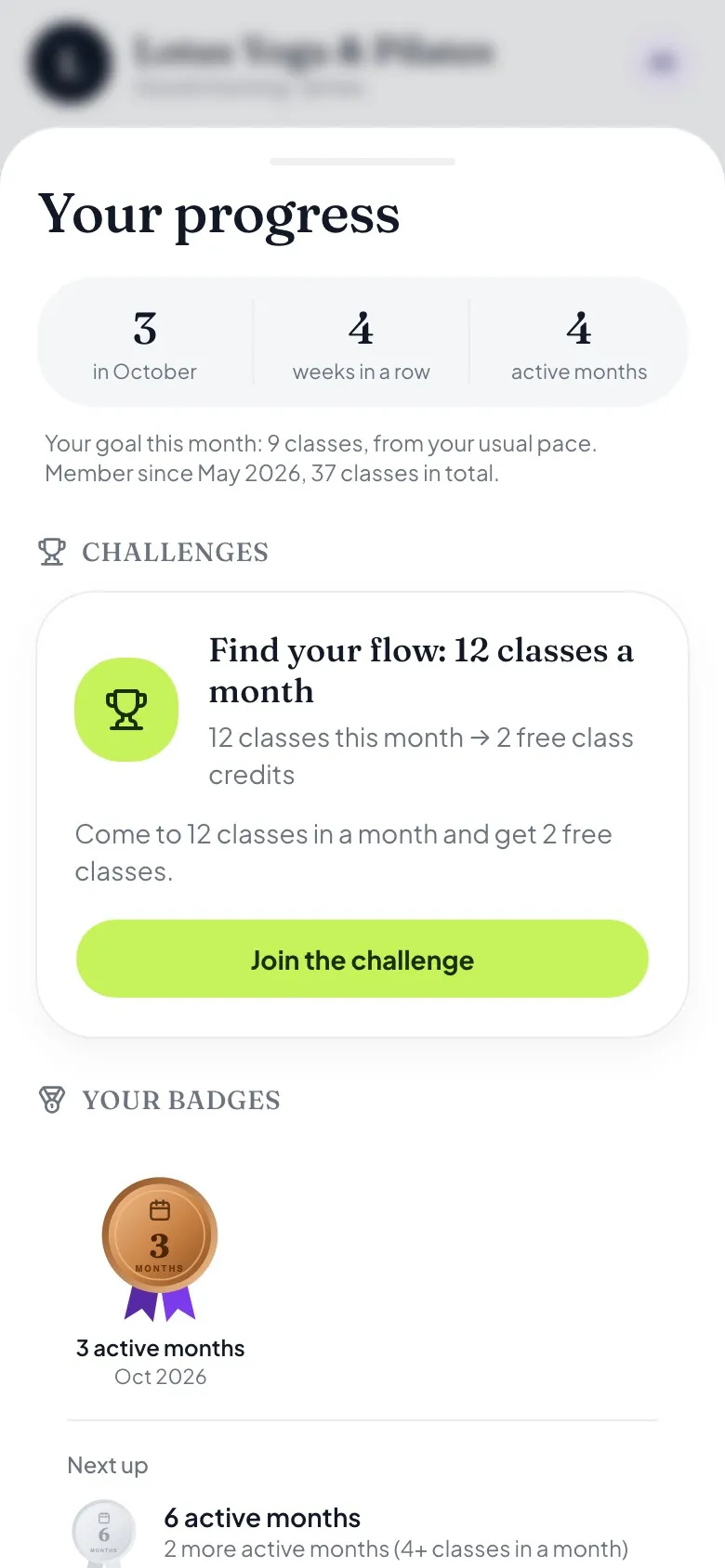
In MOTVIVO you can run challenges with monthly goals on the Studio, Club and Premier plans, and choose the reward: credits, something you name (handed over at the desk) or just a badge. In the club’s booking app, each member’s account shows a ring for this month’s classes. With My Friends, members add friends and book classes together, and refer a friend gives the friend a welcome and the member a reward once the friend makes a first purchase. You can try MOTVIVO with 14 days free, no card needed.
Questions
What is a good fitness challenge for beginners?
A short class-count challenge with a gentle goal, such as eight classes in their first month, works well for beginners. It builds a weekly habit without pressure. Let any class count, include beginner-friendly times, and greet newcomers by name when they join. Avoid weigh-ins and daily streaks, which put off people who are still finding their feet.
How long should a gym challenge last?
A month is the sweet spot for most gyms and studios. It’s long enough to turn a few classes into a weekly habit and short enough that members stay interested until the end. Run it in calendar months so the goal is easy to remember, and leave a short gap or a different type of challenge before the next one.
Should a fitness challenge have one winner or reward everyone?
Reward everyone who reaches the goal. With a prize for the top few, the keenest members pull ahead early and everyone else stops trying. A reward for every finisher keeps the whole studio motivated all month. If your members enjoy competition, add a small extra, such as a “most improved” award, on top rather than instead.
How often should I run challenges at my studio?
Many studios run one challenge at a time and change the type every month or two: a class-count challenge, then bingo, then a bring-a-friend month. Rotating keeps it fresh for regulars and gives different members a chance to shine. Plan the year in advance so each challenge supports a season, such as September restarts or quieter summer weeks.
What if a member can’t finish because of illness or travel?
Be kind and consistent. Thank them for taking part, invite them to the next round, and don’t change the goal for one person, since others will notice. If a member was injured, suggest gentler classes once they’re ready. A challenge should feel like encouragement, never like a test someone failed.