 MOTVIVO


A new member mentions a sore lower back two minutes before her first reformer class, and the teacher has to decide what to do. A good waiver and health questionnaire means that conversation happened before she booked, in writing. This guide gives you a plain-language gym waiver template with [placeholders], the health questions worth asking, and what to do about minors, pregnancy, re-signing and storing the forms. It works for gyms, Pilates and yoga studios, martial-arts and dance schools.
Please read this first: this guide is not legal advice. Whether a waiver is enforceable, and what it may say, depends on your country and the facts of each case. Use the template as a starting point, have a local lawyer review your final version, and check what your insurer requires.
What a gym waiver template should do (and what it can’t)
A gym waiver tells members honestly about the risks of exercise and records that they understood and accepted them. Most studios pair it with a short health questionnaire, so teachers know about injuries, conditions or pregnancy before the first class.
What a waiver can’t do is excuse carelessness. In many countries a business can’t sign away responsibility for its own negligence, and consumer law may not allow some limits on liability at all. Many templates online are written for US law, so treat any template, including this one, as a draft.
A lawyer who advises Pilates and yoga studios puts it simply: the waivers that let studios down were usually the vague ones. Clear, specific wording a member actually reads beats pages of fine print.
What to include in a gym waiver form
A good gym waiver form covers who is signing, what the activity involves, what the member promises you, and how you use their information.
- Who and what: your business name, the member’s name and date of birth, and the activities covered.
- The real risks of your kind of training, in plain words: muscle strains in a gym, falls or pinched fingers on a reformer, contact in martial arts, overstretching in yoga.
- The member’s part: honest health answers, telling the teacher about changes, working within their limits.
- Acceptance of risk and any release of liability, in the form your lawyer says is allowed where you are.
- Emergency contact and permission to call for help.
- Data protection: what you collect, why, who sees it and how long you keep it.
- Signature, date and version of the form, so you always know which wording someone agreed to.
Keep your booking rules out of the waiver. Cancellation cut-offs and no-show fees belong in your terms; the guide to writing a late cancellation policy has a template for that part.
Gym waiver template you can copy
Copy the text below, replace everything in [square brackets] and cut what doesn’t apply. Change the activities and it works as a Pilates or yoga waiver form too.
[Studio name] – Participation agreement and health questionnaire (version [1.0], [date])
1. Taking part. I’d like to take part in [group classes, reformer classes, open gym, personal training, online classes] at [studio name], [address].
2. Risks. I understand that exercise involves physical effort and some risk, including [muscle strains, sprains, falls, injuries from equipment, contact with other participants], and in rare cases more serious injury or a health event.
3. My health. I have answered the health questions honestly. I’ll tell my teacher about any injury, illness, pregnancy or change in my health, check with my doctor where the questionnaire suggests it, and stop if I feel pain or dizziness.
4. No medical advice. I understand that [studio name]’s teachers give exercise guidance only and don’t diagnose or treat medical conditions.
5. Rules. I’ll follow my teacher’s instructions, use equipment as shown and follow the house rules [link or where they’re displayed].
6. Accepting risk. [Wording on acceptance of risk and release of liability, as reviewed by your lawyer for your country.]
7. Emergencies. In an emergency, [studio name] may call emergency services and my emergency contact: [name, phone].
8. My information. [Studio name] uses my health answers only to keep me safe in class. Only [teachers and the front desk team] can see them. They’re kept for [period] and deleted after [when]. I can ask to see, correct or delete them at [email]. Full details: [privacy policy link].
9. Agreement. I’ve read and understood this agreement. Name: [ ] · Date of birth: [ ] · Signature: [ ] · Date: [ ]. For under-[18]s: parent or guardian name and signature [ ].
Health questionnaire for your gym or studio
A health questionnaire for a gym should be short, yes/no and focused on safety in class, not a medical history. The best-known model is the PAR-Q (Physical Activity Readiness Questionnaire), which asks a handful of screening questions and sends anyone who answers “yes” to check with a doctor. You can use the current official PAR-Q+ or write your own in the same spirit, for example:
- Has a doctor ever told you to limit physical activity, or to exercise only under medical supervision?
- Do you have a heart condition or high blood pressure, or do you feel chest pain during activity?
- Have you lost consciousness, or lost your balance because of dizziness, in the past year?
- Do you have an injury, or a bone, joint or back problem, that could be made worse by exercise?
- Have you had surgery or a serious illness in the past [6] months?
- Are you pregnant, or have you given birth in the past [6] months?
- Do you take medication or have a condition (such as diabetes, asthma or epilepsy) your teacher should know about in an emergency?
- Anything else your teacher should know? (optional)
Phrase it carefully. Ask what matters for training and nothing more, and never let staff interpret answers medically.
Decide what a “yes” means before you need it. A common approach: the member checks with their doctor before joining in, the teacher is told, and modifications are agreed. What owners run into: people rarely mention an injury until something hurts, so keep asking “anything I should know today?” at the start of class.
Minors, pregnancy and other special cases
Children, pregnant members and online classes each need a line of their own in your waiver, and a clear rule for your team.
- Minors. A parent or guardian signs for anyone under the age of adulthood where you are, and answers the health questions for them. Children’s classes should also note who may collect the child. Ask your lawyer how far a parent’s signature counts in your country.
- Pregnancy and after birth. Decide your studio’s rule in advance: which classes are suitable, whether you ask for the doctor’s or midwife’s OK, and which teachers have pre- and postnatal training. Ask members to tell you if they become pregnant later.
- Online classes. Add a sentence about members checking their own space and equipment, since no teacher is in the room.
- Trial classes and guests. First-timers and friends who come along are the ones most likely to skip the form. If you run intro offers, make the waiver part of booking the offer, not something handed over at the door.
When members should sign your waiver again
Members should sign again when the wording changes in a way that matters, and update their health answers regularly:
- New version of the waiver (new activities, new risks, new release wording): everyone signs before their next class. A typo fix doesn’t need a new round.
- Health answers: refreshed once a year, after a long break, and whenever a member tells you about an injury, an operation or a pregnancy.
- Your insurer’s rules: some policies ask for a yearly signature. Check yours.
Put a version number and date on every form, so each signature belongs to one wording.
Storing waivers and health data safely
Store waivers so you can find any member’s signed version quickly, and health answers where only the people who need them can see them. Paper forms at the front desk are the weak spot: they get lost, and anyone at the desk can read them.
Health answers are personal health data, which needs extra care. In the EU (Cyprus included) the GDPR applies, and it treats health information as a special category of personal data. In practice, careful owners:
- ask only the questions they need for safety;
- explain on the form why they ask, who sees the answers and how long they’re kept;
- keep marketing consent completely separate from the health form;
- decide when old forms are deleted, and handle members’ requests to see or delete their data.
Your legal basis, how long to keep signed waivers and what your privacy policy says are questions for a local lawyer or data protection adviser. Setting up? Add it to your list next to insurance in the guide on how to open a Pilates studio.
How MOTVIVO helps
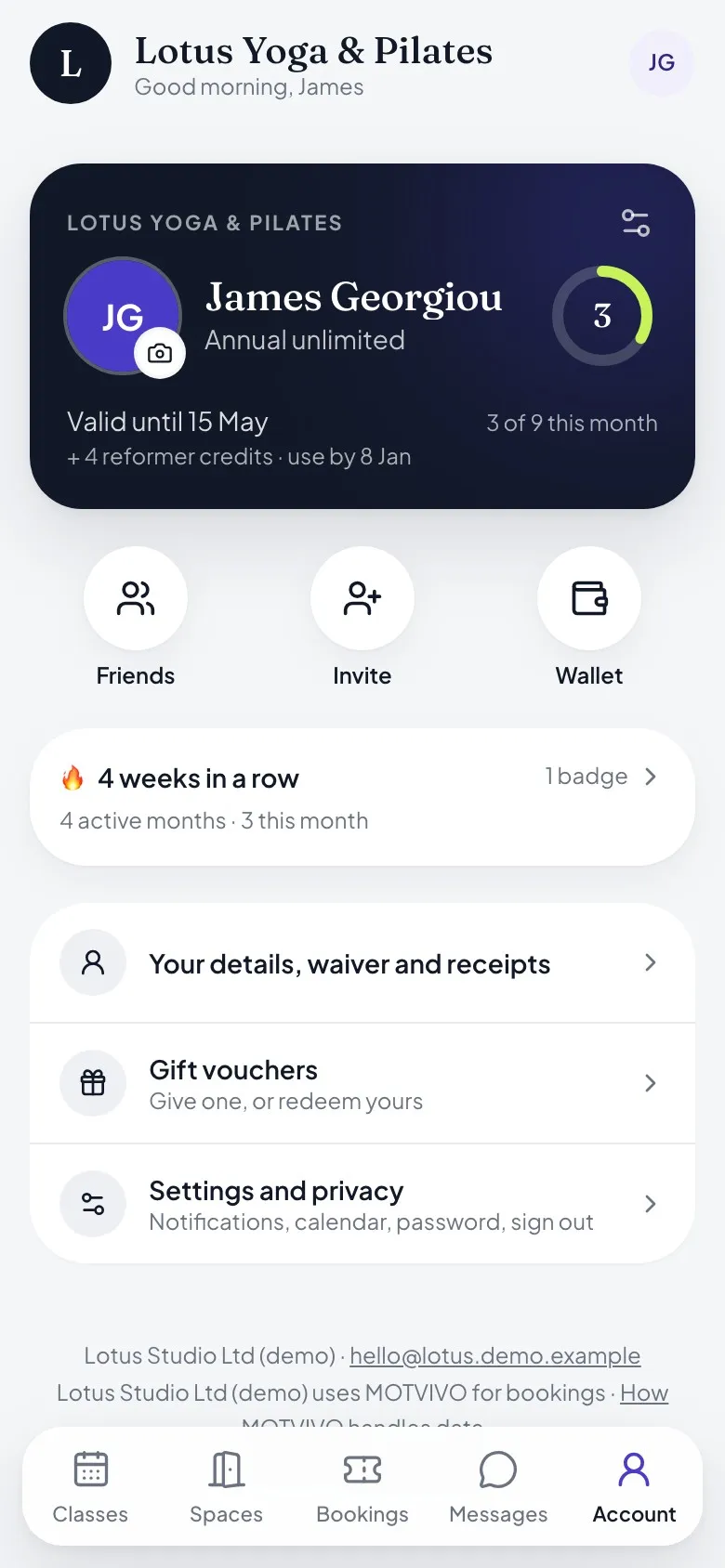
- Members sign your waiver and answer your health questions in the booking app before they book online. You choose whether they re-sign every 6 or 12 months or only once, and after changing the text you can ask everyone to sign again.
- Members may decline the health questions. A “yes” never blocks a booking: it shows a health flag on the class list that the teacher sees before class.
- Trainers see only the flag; the answers are visible to admins, managers and the front desk. If a signature is missing, the member’s card in the app shows one button: sign the waiver.
See class booking and check-in on a tablet. The first 14 days are free, no card needed.
Questions
Is a gym waiver legally binding?
It depends on your country and the situation. A clearly written, signed waiver usually shows that a member understood the risks, but in many places it can’t protect a business from its own negligence, and consumer law may limit what it can say. Have a local lawyer review your wording, and check that it matches what your insurance policy requires.
Do I need a separate Pilates or yoga waiver form?
Not a separate document, but the risks section should describe your actual classes. A reformer studio mentions springs, straps and moving carriages; a yoga studio mentions stretching, balances and inversions; a martial-arts school mentions contact. One waiver can cover several activities if each is named, which is simpler for members who do more than one.
What should we do when someone answers “yes” on the health questionnaire?
Follow the rule you decided in advance, and don’t give a medical opinion. Usually that means asking the member to check with their doctor before joining in, telling the teacher before class, and agreeing on modifications. Note what was agreed. If the answer is about pregnancy or a recent operation, a written OK from their doctor or midwife is common.
What about walk-ins who haven’t signed anything?
Ask them to sign before they train, even for a single class. A tablet at the desk or a QR code that opens your form is faster than paper and keeps the signed copy with their details. Making signing part of booking keeps walk-ins rare. The guide to running your studio front desk covers handling walk-ins calmly.
How long should we keep signed waivers?
There’s no single answer: it depends on how long someone could bring a claim in your country and on data protection rules, which pull in opposite directions. Ask your lawyer for a retention period, write it on the form, and delete health answers you no longer need. Keep the signed waiver and the health answers separately if they have different periods.