 MOTVIVO


Class pack vs membership is a question every studio owner faces sooner or later: what should you sell, and should you offer both? Packs feel fair and are easy to buy. Memberships bring steadier income and regulars who come every week. This guide covers who each option suits, unlimited or limited memberships, expiry dates, how to price your classes with a simple price ladder, and how to move regulars from packs to memberships.
Class pack vs membership: the short answer
A class pack is a bundle of classes paid up front: a 5-class or 10-class pack that the member uses within a set period. A membership covers a stretch of time, a month, a term or a year, with classes either unlimited or limited per week or per month.
Most small studios do best with both. Packs are the low-commitment way in. Memberships are where your regulars settle.
Who a class pack suits
- People with changing schedules: shift workers, parents, people who travel for work.
- Members who come once a week or less and want to feel they only pay for what they use.
- Newcomers who liked their first class but aren’t ready to commit to a monthly plan.
- Visitors who are in town for a few weeks.
Who a membership suits
- Regulars who come twice a week or more and would rather not count classes.
- People building a habit: a fixed plan gives them a reason to show up.
- Members who like a clear monthly cost, the same way they pay for a phone plan.
Class packs vs memberships: cash flow or flexibility?
Memberships give you steadier cash flow; packs give members flexibility. That is the real trade-off.
- Memberships give you predictable income. You know roughly what comes in each month before the month starts.
- Packs bring money in early but unevenly. A busy January of pack sales can be followed by a quiet March.
- Packs give members flexibility. That makes them easier to sell, especially to people who have been burned by a gym contract they never used.
A useful way to think about it: packs win the first sale, memberships keep the relationship. You want both doors open, and a clear path from one to the other.
Membership vs subscription: monthly renewal or a fixed period?
The words overlap; what matters is how the plan runs. A subscription-style plan renews and charges every month until the member stops it. A fixed-period membership covers a set time (a month, a term or a year) and simply ends unless the member renews it. Monthly renewal gives you steadier income; a fixed period feels safer to people wary of contracts. Whichever you offer, say clearly how long it runs, whether it renews by itself and how to stop it. For renewal and cancellation terms, check with a local lawyer or accountant.
Unlimited Pilates membership or weekly limits?
Unlimited suits classes with room to spare; for small reformer classes, where every spot counts, a weekly or monthly limit is usually fairer. Unlimited is attractive to members, so the question is whether your timetable can carry it.
- Unlimited works well for mat classes with room to spare, and for members who come often and bring energy to the room.
- A weekly limit (for example, 2 classes a week) keeps busy classes fair and spreads members across the week.
- A monthly limit (for example, 8 classes a month) gives members more freedom: two classes one week, three the next, none during a holiday.
To decide, look at your own timetable: how many spots you have per week, how full your busiest classes are, and how often your current regulars actually come. If your 6:30 reformer class is always full and unlimited members would take most of it, a limit protects room for everyone. Pair it with a clear late-cancellation policy, so nobody books spots they don’t use.
Expiry dates, premium classes and pay later
Three details decide whether your packs and memberships feel fair: when credits expire, which classes they cover, and what happens when a regular runs out.
Expiry dates on class packs
Packs without an expiry date tend to sit unused, and members drift away with credits left. An expiry date gives people a gentle reason to come back. Keep it generous enough to feel fair; a smaller pack can have a shorter window. Show the expiry date at purchase and remind people before credits run out (more on catching renewals and last credits). Rules on expiring prepaid services differ by country, so check with a local lawyer or accountant.
Premium classes
If some classes cost you more to run (reformer, private-style small groups, a visiting teacher, workshops), you don’t have to include them in every plan. Common approaches:
- A separate pack or membership for premium classes only.
- Premium classes cost more than one credit from a general pack.
- Workshops sold on their own, with a member price as a thank-you.
Whatever you choose, members should know before they book whether a class is covered by what they already have.
Pay later for regulars
Some regulars forget to renew, or their pack runs out the day before class. Turning them away feels wrong, but an open tab can grow without anyone noticing. A small, fixed limit solves this: trusted members can book and pay later up to an amount you choose, and settle at the desk or with online payments.
How to price your classes: a simple price ladder
Price your classes as a ladder: arrange your whole price list as steps, from the easiest first purchase to the best-value commitment, with the price per class falling at each step. Keep the main list short; with too many options people stop reading.
The prices below are hypothetical examples to show the shape of a ladder, not recommended prices. Work out your own from your costs, your area and your class sizes; if you’re still planning, start by working out your break-even.
| Step | Option (example) | Example price | Example price per class | Who it’s for |
|---|---|---|---|---|
| 1 | Intro offer: 3 classes in 2 weeks, new members only | €30 | €10 | First-timers |
| 2 | Drop-in | €18 | €18 | Visitors, one-offs |
| 3 | 5-class pack, valid 2 months | €80 | €16 | Once a week or less |
| 4 | 10-class pack, valid 4 months | €140 | €14 | Flexible regulars |
| 5 | Membership, 2 classes a week, monthly | €100 | about €11.50 if used fully | Steady regulars |
| 6 | Unlimited membership, monthly | €130 | falls the more they come | Your most frequent members |
What makes this ladder work:
- The drop-in is the highest price per class, so any pack or membership feels like a good decision.
- The price per class falls at each step, so moving up always makes sense for someone who comes more often.
- The intro offer is time-limited and for new people only, so it welcomes first-timers without undercutting what your regulars pay.
To check your own ladder, divide each price by the number of classes someone realistically takes. If a 10-class pack ends up costing more per class than your membership for someone who comes twice a week, you have the order right.
Moving people from a class pack to a membership
The best moment to suggest a membership is when someone is about to buy their second or third pack, or is on their last credit. You’re simply showing them a better deal for what they already do.
- Do the sum for them. “You’ve come 8 times this month. On the 2-a-week membership that would have cost you less.”
- Make the switch easy. If they have credits left, let them use those first, or count them towards the first month.
- Say it in person. A quick word after class from the instructor who knows them works better than a discount email.
- Don’t push. Some people genuinely prefer packs. A happy pack member is still a regular.
How to present your options clearly
Lead with who each option is for and show the price per class: a price list should take seconds to understand. A few habits help:
- Lead with who each option is for (“Coming twice a week?”), not with fine print.
- Show the price per class next to each pack and membership so people can compare at a glance.
- Highlight one option as the one most regulars choose, so undecided people have a sensible default.
- Put expiry dates, limits and what’s included in one plain line under each option.
- Use the same names and prices everywhere: website, booking app, desk and Instagram.
Here is a short text you can adapt for your website or the sign at your desk:
New here? Start with our intro offer: 3 classes in your first 2 weeks.
Coming now and then? A 5- or 10-class pack. Use your classes whenever suits you within [validity].
Coming every week? The 2-a-week membership is what most of our regulars choose. Book up to 2 classes each week for [price] a month.
Here most days? Unlimited membership: come as often as you like for [price] a month.
[Reformer / workshops] are booked separately. Ask us at the desk if you’re not sure which option fits you.
How MOTVIVO helps
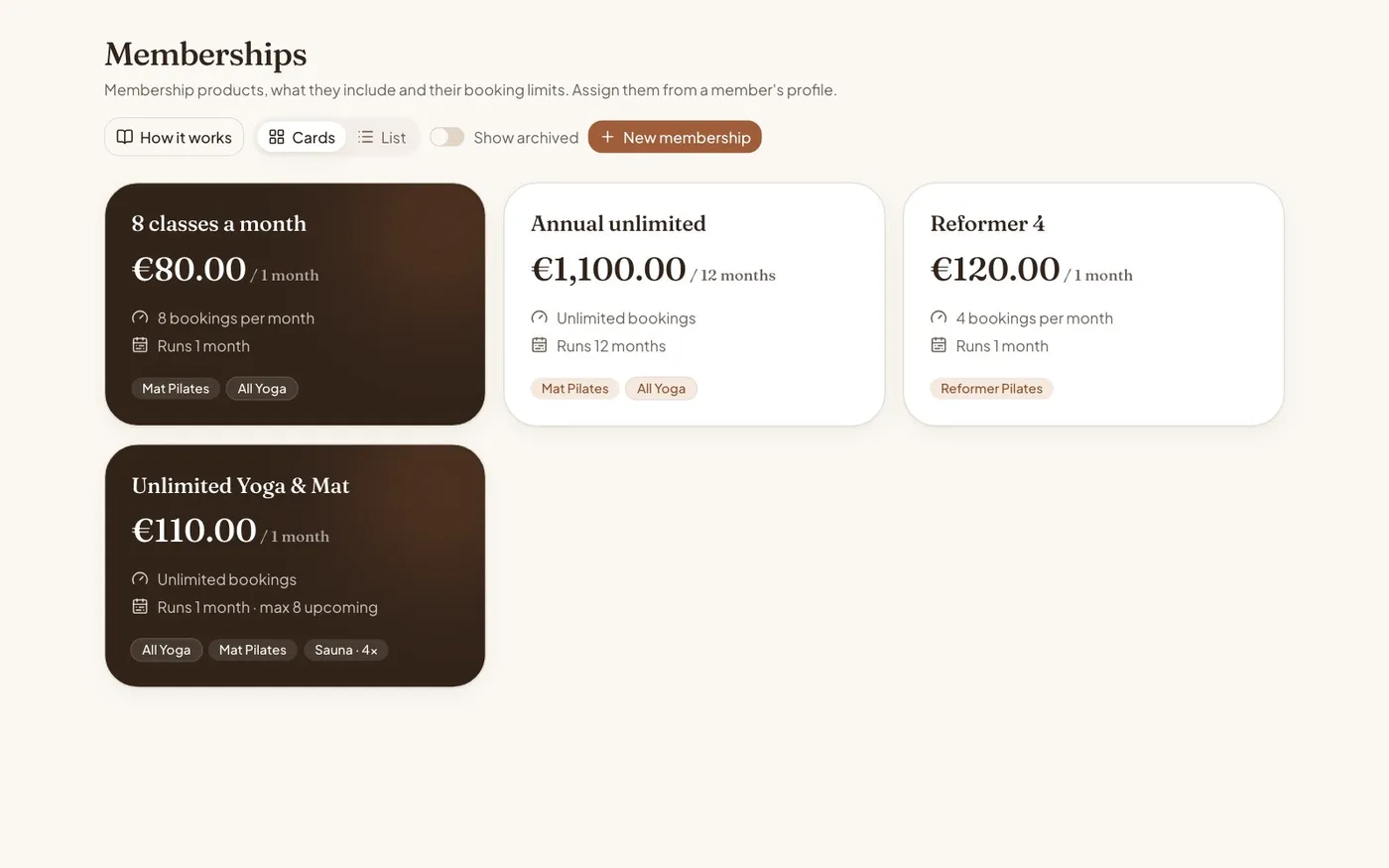
- Set up memberships (unlimited or with weekly or monthly limits, for a month, a term or a year), class packs with credits and expiry dates, and drop-in prices.
- Sell them online through your own Stripe account or at the desk, and let trusted regulars pay later up to a limit you choose.
- Members see whether a class uses their membership or their credits before they book, in your club’s own booking app.
- Each morning, Today shows memberships ending soon and members on their last credit, so you know who to talk to about the next step.
See how it works on the memberships and class packs page. The first 14 days are free, no card needed.
Questions
Is a class pack or a membership better for a small Pilates studio?
Most small studios offer both. Class packs are the easy first purchase for newcomers and people with changing schedules. Memberships suit regulars who come every week and give you steadier monthly income. Price them so that moving from a pack to a membership is the better deal for anyone who comes often.
Should I offer an unlimited Pilates membership?
Offer it only if your classes have room for it. Unlimited works well for mat classes with spare spots and members who come often. For small reformer classes, a weekly or monthly limit keeps spots fair for everyone. Look at how full your busiest classes are before deciding.
What is the difference between a membership and a subscription?
The useful difference is how the plan runs. A subscription usually renews and charges every month until the member stops it; a membership can also cover a fixed period, such as a term or a year, and end unless renewed. Whichever you offer, state clearly how long it runs, whether it renews and how to stop it, and check the terms with a local lawyer or accountant.
Should class packs expire?
Usually yes, with a generous window. An expiry date helps people keep coming and stops credits sitting unused for months. Show it clearly when someone buys, and remind them before it runs out. Rules on expiring prepaid services vary by country, so check with a local lawyer or accountant.
Where do drop-ins and intro offers fit in?
Drop-ins are for visitors and one-off classes, and usually carry the highest price per class. An intro offer is a short, time-limited deal for first-timers only. Both lead people towards a pack or membership once they decide to come regularly.